


It's 11 p.m. on a busy ward. A nurse finishes a dressing change, drops the gauze into a red bag, and then drops a coffee cup and a plastic wrapper in after it. Nobody notices. Next week the hospital pays the regulated medical waste price for all of it.
Multiply that by every ward, every clinic and every shift, and you get one of healthcare's quietest money leaks. Most of the problem is not the waste. It's the missing data.
The good news: in 2026-27, AI and real-time tracking can show hospitals and clinics exactly what goes into each bin, when it leaves the building and what they are billed for it. This guide explains how that works, what it fixes, and how DibHub builds this kind of software.
The short answer: what does real-time medical waste tracking do?
A real-time medical waste tracking system does five things:
Gives every container an identity: a QR code, barcode or RFID tag, so each bag, sharps box and bin can be traced.
Checks segregation at the source: AI flags general waste going into the wrong stream before it costs money.
Tracks every pickup live: GPS, timestamps, photos and e-signatures prove what was collected and when.
Keeps compliance records automatic: manifests, logs and audit trails are created as the work happens, not rebuilt at audit time.
Matches invoices to real service: every charge is checked against actual pickups and weights.
The numbers: where the money goes
About 85% of healthcare waste is general, non-hazardous waste. Only about 15% is hazardous (World Health Organization).
Regulated medical waste can be less than 8% of a hospital's total waste but cost more than 40% of its waste management budget (Practice Greenhealth).
Nearly $200,000 a year: what Inova Fairfax Hospital saved in disposal fees through better segregation and staff education (Practice Greenhealth).
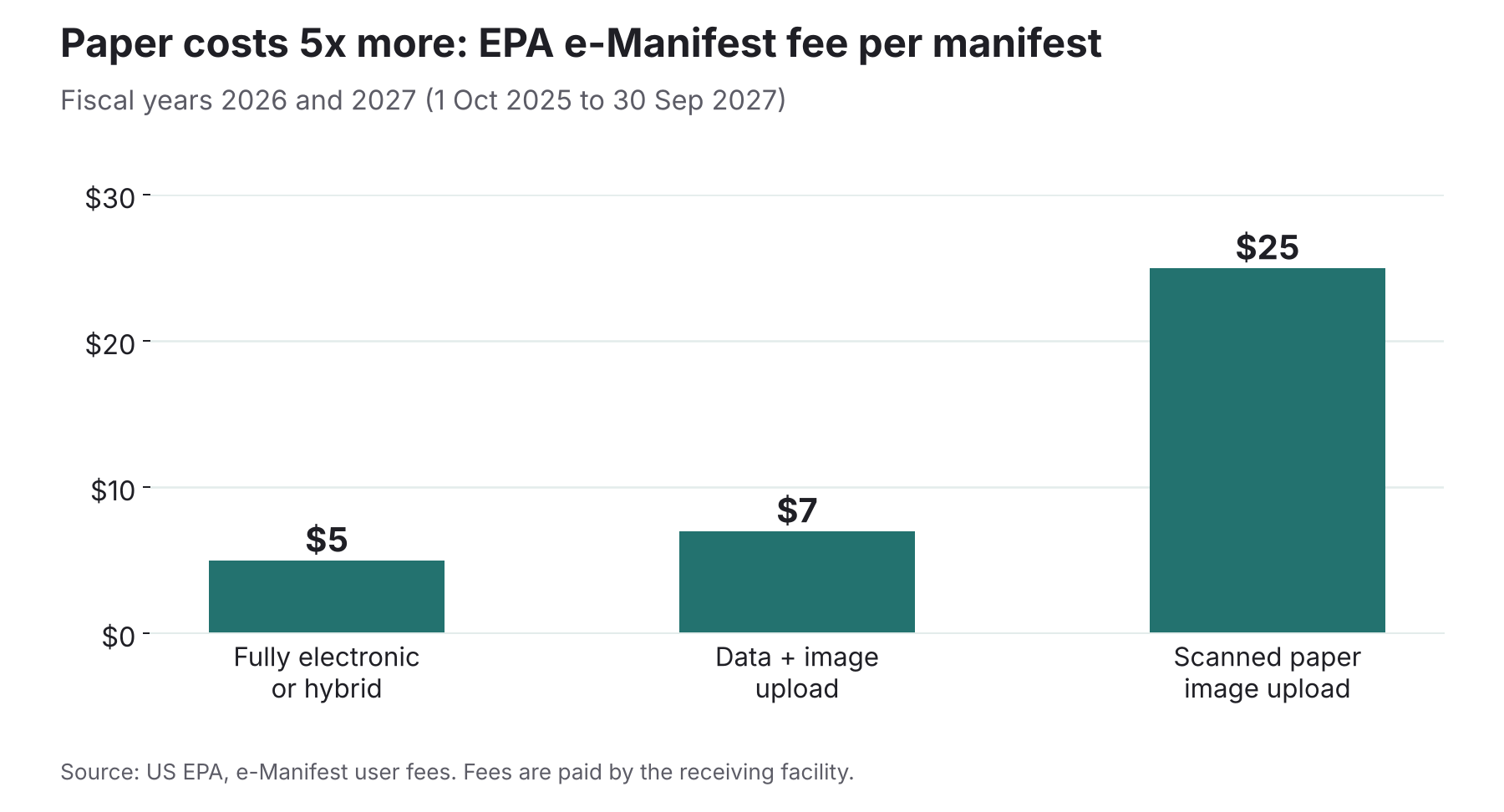
$5 vs $25: EPA's fee for a fully electronic hazardous waste manifest compared with a scanned paper one, for fiscal years 2026 and 2027 (paid by the receiving facility).
$16,550 per serious violation and $165,514 per wilful or repeated violation: OSHA's maximum penalties, unchanged for 2026.
95.06% accuracy: what a 2025 computer vision research study reached when classifying medical waste images into 23 categories with a YOLOv5 model (arXiv, 2025).
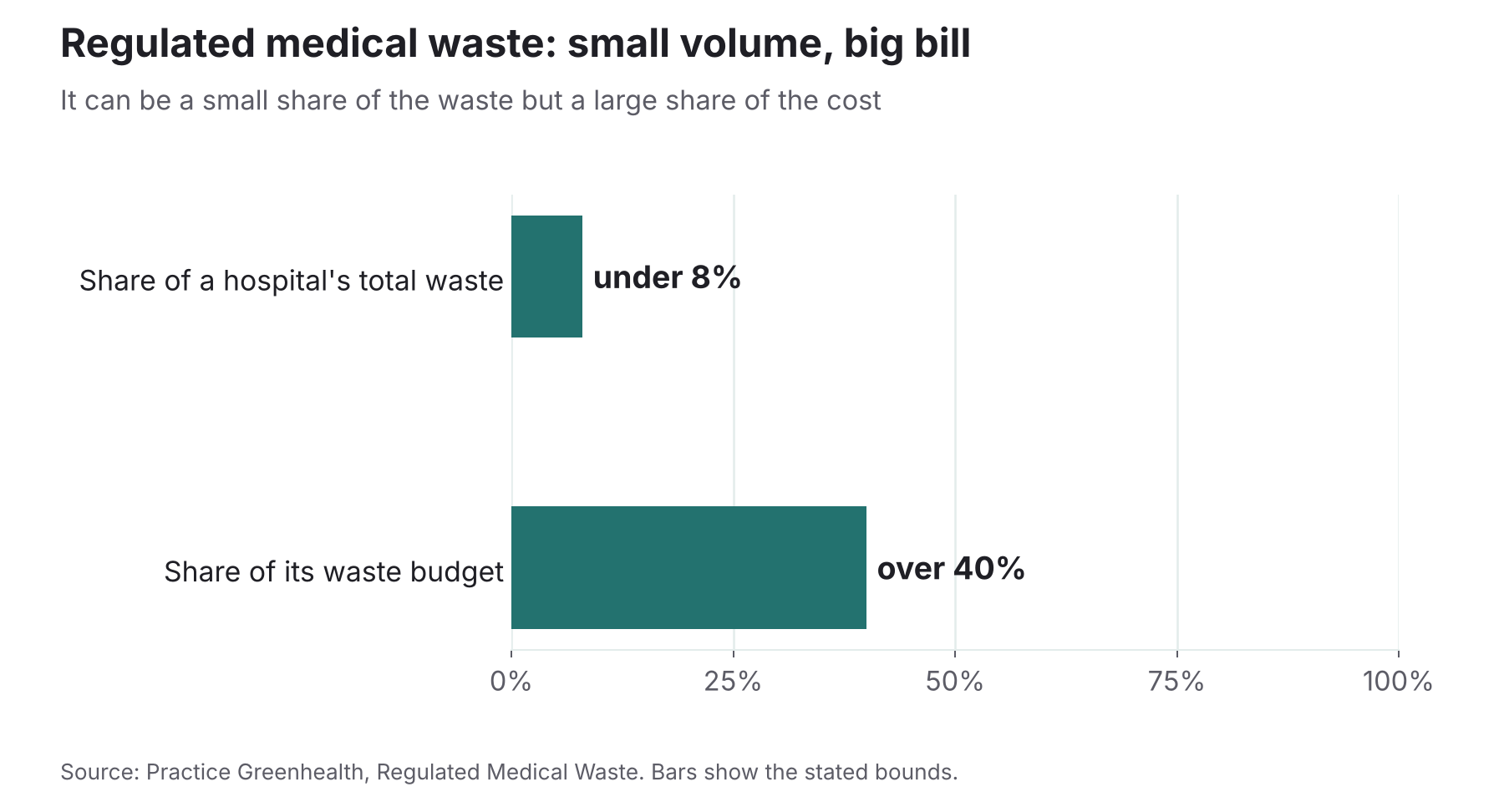
The lesson is simple: the expensive stream is small. Keep it small and accurate, and the savings follow.
The problems hospitals and clinics face in 2026
1. The wrong waste in the wrong bin. General waste ends up in red bags because bins sit in the wrong place, labels are unclear or staff are rushed. Every wrong item is paid for at the regulated rate.
2. Paper logs and late paperwork. Many facilities still track pickups on paper or in spreadsheets. Under EPA rules, a large quantity generator that does not get a signed manifest back within 35 days must chase the transporter, and after 45 days it must file an exception report. Paper makes those deadlines easy to miss.
3. No live view across locations. A group with ten clinics often can't answer a basic question: how much regulated waste did each site produce last month, and why did site four double?
4. Invoices that don't match the service. Billing is hard to get right, even for the biggest companies. In October 2026, Waste Dive reported that WM's healthcare waste business, the former Stericycle, had faced ongoing billing challenges, a rocky ERP integration and some customer churn after the merger. Leadership says those problems are now largely fixed, with heavy manual effort along the way. If waste data is hard at that scale, it's harder for a hospital checking invoices by hand.
5. Audit panic. When records live in binders, inboxes and vendor portals, every inspection becomes a week of searching.
Paper and spreadsheets vs real-time AI tracking
Paper and spreadsheets | Real-time AI tracking | |
|---|---|---|
Segregation errors | Found after the bill arrives, if at all | Flagged at the bin, as they happen |
Pickup proof | Signatures on paper, easy to lose | GPS, timestamp, photo and e-signature |
Manifests | Scanned and uploaded later | Electronic, created at pickup |
Missing manifests | Noticed close to the deadline | Automatic alerts before day 35 |
Multi-site view | Monthly spreadsheets from each site | Live dashboard per site and department |
Invoice checks | Manual, often skipped | Every line matched to real pickups |
Audit prep | Days of searching | Minutes, with a full audit trail |
How real-time AI tracking works, step by step
Step 1: Tag every container. Each bin, bag and sharps container gets a QR code, barcode or RFID tag linked to its waste stream, department and site.
Step 2: Check segregation with AI. A camera above a bin, or a photo taken on a phone, runs a computer vision model (such as YOLO) that recognises common items and warns staff when general waste lands in a regulated stream. Smart scales and fill-level sensors (IoT) add weight and fullness data.
Step 3: Stream every event. Each scan, weight and pickup becomes an event sent through a message queue into a secure cloud database. Nothing waits for someone to type it in.
Step 4: Prove every pickup. The driver's mobile app records GPS location, time, container IDs, photos and an e-signature. The facility sees the pickup on its dashboard within seconds.
Step 5: Let AI read the paperwork. Large language models with vision extract data from manifests, certificates of destruction and invoices, then match each line to the recorded pickups and weights.
Step 6: Connect to the systems that matter. EPA's e-Manifest system offers public APIs, so manifests can be created and checked electronically. Dashboards, alerts and reports connect to the tools a hospital or clinic group already uses.
Step 7: Spot problems before they cost money. Anomaly detection flags a sudden jump in red-bag weight, a missed pickup, a manifest heading towards its deadline or an invoice that doesn't match the service.
Who benefits most
Hospitals: lower regulated waste costs, cleaner audits and a live view by department.
Clinic groups and dental groups: one dashboard across every location, instead of a spreadsheet from each site.
Labs and outpatient centres: simple tracking without a big IT project.
Medical waste haulers: route planning, proof of pickup and invoices customers trust, which is how independent haulers win business from bigger competitors.
How DibHub builds this kind of software
We'll be straight with you: our work so far has been in healthcare software and logistics, not a ready-made waste product. What we have built are the exact building blocks a real-time waste tracking platform needs.
From TruxOps, our freight dispatch platform:
Live dispatch and routing with HERE routing and address APIs
AI document extraction that reads bills of lading and proof of delivery documents with vision models
Secure document storage on AWS S3 with private access controls
Event-driven workflows built on AWS EventBridge Scheduler and SQS queues
Government data integrations, such as FMCSA carrier data through public APIs
From AllTreat, a multi-location healthcare platform:
Multi-tenant, multi-facility architecture, so each location's data stays separate and secure
EHR integrations with Open Dental and CharmHealth
Role-based access control, so each person sees only what they should
Live reporting across locations and providers
Put together, that's a pickup app, AI that reads documents, an event pipeline, secure multi-site data and healthcare-grade access control. That is real-time medical waste tracking.
We build with React, React Native, NestJS, PostgreSQL and AWS, and we add AI where it saves time or money, not as decoration.
5 questions to ask before choosing waste tracking software
Does it track every container from the bin to final disposal, with proof at each step?
Can it flag segregation mistakes before pickup, not after the invoice?
Does it create electronic manifests and warn you before the 35-day mark?
Can it show every site and department on one dashboard?
Does it check every invoice line against real pickups and weights?
If the answer to any of these is no, there's money and time left on the table.
The bigger lesson
Hospitals don't need more bins. They need better data. AI makes waste visible: what goes in, where it goes and what it really costs. Once it's visible, it's fixable.
If you run a hospital, a clinic group or a medical waste company and want real-time tracking built around how you actually work, book a free 30-minute consultation with a senior DibHub engineer.
Faique Ali Raza
Business Development Lead
DibHub
FAQs
What is real-time medical waste tracking?
Real-time medical waste tracking uses QR codes, barcodes or RFID tags, mobile apps and cloud software to follow every waste container from the bin to final disposal. Each scan, weight and pickup is recorded as it happens, with GPS, time stamps, photos and e-signatures.
How does AI help hospital waste management?
AI checks segregation with computer vision, reads manifests and invoices with document AI, and flags unusual patterns such as a sudden jump in red-bag weight or a missed pickup. That reduces regulated waste costs and keeps compliance records complete.
Why is regulated medical waste so expensive?
It needs special handling, transport and treatment. Practice Greenhealth notes that regulated medical waste can be less than 8% of a hospital's waste but more than 40% of its waste budget, so general waste placed in red bags raises costs quickly.
Are EPA hazardous waste manifests electronic now?
EPA has run the e-Manifest system since 2018 and stopped accepting mailed paper manifests in June 2021. For fiscal years 2026 and 2027, a fully electronic manifest costs $5 compared with $25 for a scanned paper one.
Can DibHub build a medical waste tracking system?
Yes. DibHub builds custom software with React, React Native, NestJS, PostgreSQL and AWS, and has delivered the core parts this needs: live dispatch, AI document extraction, event-driven workflows and secure multi-location healthcare data. You can book a free 30-minute consultation with a senior engineer.




Comments
Loading comments…